
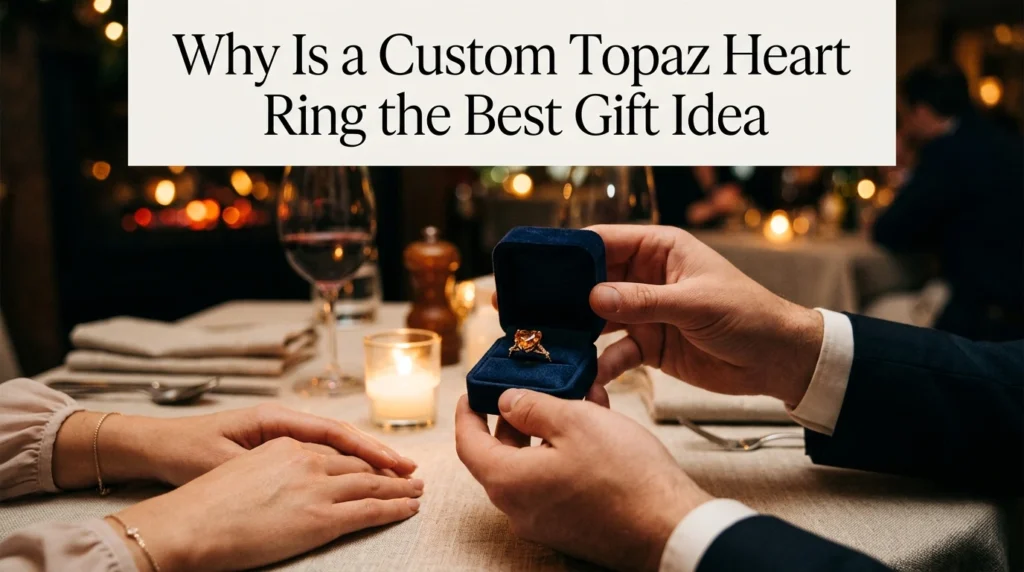
Giving jewelry that was made for one specific person feels different from anything else you can hand over. There is a significant difference in the experience of giving jewelry that has been designed specifically for one individual as opposed to simply handing over a piece that has been mass-produced. A rushed order placed under time constraints or a hasty selection from a display case cannot adequately justify this distinction. Instead, it requires making decisions after giving careful consideration to the preferences of the recipient with regard to the color, shape, and size of the item under consideration. That is why a topaz heart ring keeps coming up when people sit down and actually think about what they want to give, instead of just grabbing something reasonable.
The combination holds up on its own terms. A heart shape is direct about what it is communicating. Topaz brings color options most gift givers do not expect going in. And having it made custom means no one else has the same one. Not a near version. The same one.
What Makes a Topaz Heart Ring Stand Apart from Generic Jewelry
There are two primary ways in which generic jewelry typically fails. In the first place, it is frequently derived from a factory production line, which makes it easily recognizable and devoid of any distinctive qualities. On the other hand, it may be quite pricey, but it may still have a generic feel to it, as if it could be worn by anyone, rather than being tailored to the specific needs of the individual. You can buy the “right” thing, and it still ends up saying nothing specific about the person wearing it.
Before you dismiss the stone like it’s safe or too normal, take a minute to understand it. Topaz comes in more shades than most people imagine when they hear the word. Sure, pale blue exists. But there’s also deep, imperial gold, vivid pink, and clean white. And when you’re making something custom, that wider palette actually matters. The color becomes part of the message, not just decoration. A soft blue can fit someone who likes quiet routines and careful thinking. A warm gold can fit someone who takes up space without even trying. A clean white can fit the type who finds extra sparkle distracting and wants the form to do the heavy lifting.
The heart cut reduces ambiguity that some softer shapes may leave open to interpretation. Some pieces communicate through understatement, and honestly that’s fine. But if the goal is real emotional weight, a heart isn’t something that needs extra interpretation by the wearer. It’s a direct choice. Not a lazy one.
Customization Is What Separates a Good Gift from a Great One
Easy gifts are often obvious in their simplicity. The wrapping may be attractive, and the price might seem reasonable, but the recipient quickly realizes that the selection process didn’t require much thought. It isn’t exactly an insult; it just lands differently when the thought isn’t visible.
Custom work leaves the proof behind. Metal type, stone size, band width, finish style, engraving, and the way the stone is set all contribute to the overall design. Each choice by itself is small. Together, these choices create an impression of deliberation, as they were intentionally made. This sense of “decided-ness” is difficult to replicate and is often easily noticed.
Engraving, though, deserves its own spotlight. A date. Initials. A phrase pulled from a conversation that would mean absolutely nothing to anyone besides you two. Little details like that turn the ring into a record, not just an object. Also, engraving maintains its significance in a way that a vibe cannot. Daily wear does not diminish it. Even after ten or twenty years, it still conveys the same message, and that level of permanence represents a type of durability that no hardness chart can truly encapsulate.
Topaz Brings Durability Without Sacrificing Color
A ring that gets worn regularly has to survive real life. Topaz scores 8 on the Mohs hardness scale, which places it in that comfortably reliable group of stones. You don’t need to hand over a little pamphlet of “be careful or else” instructions. It’s made for everyday use, and it tends to wear well.
That combo—solid durability plus actual color variety—is also rarer than people think. Stones that are tough often end up colorless or stuck in a tight range. Stones that are bright and unpredictable in tone usually ask for more attention. Topaz sits right at that overlap, without forcing you into a trade-off. You choose what fits the person, and the durability follows through.
Who This Gift Actually Works For
You can’t pretend this is a one-size-fits-all gift; it just isn’t. This works best for someone who notices details, who spots that the decisions weren’t default, and who treats jewelry as personal, not just something required for “proper dressing.”
It fits a partner who says she doesn’t want something expensive; she wants something meaningful for real. It fits a mother who still keeps wearing a piece from thirty years back because of what it stands for. It fits a friend with a distinct style who would genuinely wear a ring made with her colors and preferences in mind. In the end, personalization is the point, and it lands best with people who actually register that the choice was made for them, not for “anyone.”
The Case for Making It Custom
Gifts fail for a handful of familiar reasons. They feel interchangeable. They get set aside after a year. They read as an obligation fulfilled rather than actual attention paid. A well-made, custom topaz heart ring handles those problems, but not in a tidy matched sequence. It handles them because the whole object was shaped around one person. That is what custom means. Not a better version of a generic thing. A different kind of thing entirely.
What it asks from the giver is knowing something real about the person on the other end. When that knowledge is there, the ring shows it without needing to announce it.