
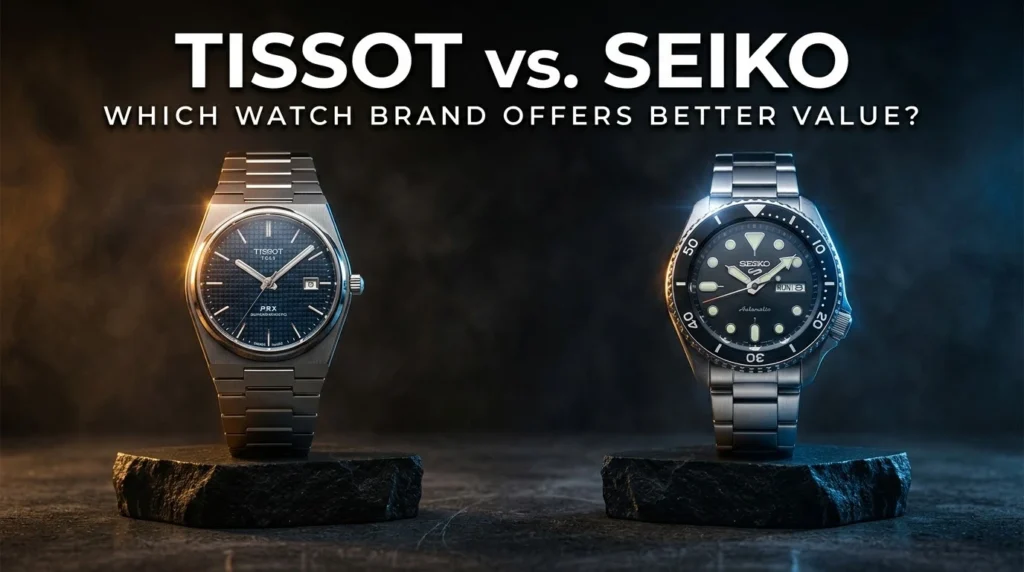
Walk into any watch forum, and this question surfaces within minutes. Someone is always trying to choose between these two, usually with a budget in the 300–600 range and a decision deadline that is closer than they’d like. The Tissot vs. Seiko debate has been running long enough that entire Reddit threads have ossified into sticky posts, and yet it keeps coming back because it’s a genuinely hard call—not because both brands are the same, but because they are different in ways that matter differently to different buyers. Both are Japanese and Swiss, and they have been manufacturing watches for longer than most countries have had constitutions. Getting this choice right means understanding what each brand actually prioritizes—not what their marketing says.
Tissot vs. Seiko: Heritage and Core Philosophy
Tissot was founded in Le Locle, Switzerland in 1853. Seiko followed in Tokyo in 1881. That is roughly the same era, with very different DNA. Tissot built its identity around Swiss heritage—the “Swiss Made” designation, the credibility that comes with that mark, and a consistent design language rooted in European watchmaking tradition. Seiko went a different direction. Rather than selling a lifestyle, it kept engineering. While Tissot democratizes the Swiss luxury experience, Seiko democratizes watchmaking itself—the actual craft, the movements, and the materials. That difference shows up everywhere once you know to look for it.
Movement Technology: Where the Specs Get Real
Seiko almost makes everything in-house, I mean pretty much. Even the reasonably priced quartz components included in the $60 department store item, as well as the hand-finished mechanism found within a $4,000 Grand Seiko. To be honest, not many other manufacturers, regardless of price range, actually accomplish it. They also got in early with solar-powered watch tech and kinetic quartz movements that pull energy from wrist motion. Those are engineering firsts, not just “oh, we rebranded some supplier parts” vibes. The 4R36 automatic caliber that runs a lot of the mid-range lineup gives you around 41 hours of power reserve, which is okay but not mind-blowing.
Now Tissot’s response is the Powermatic 80, and this one stretches to 80 hours of power reserve. That’s almost double the 4R36, and yeah, it’s a real perk if you rotate watches, or you forget to wind up before a weekend, or whatever. The Powermatic 80 also runs at 3 Hz, so you get a smoother sweep and better shock tolerance. Tissot develops its movements through the Swatch Group network, so you get more consistent quality control, though it doesn’t have that full vertical integration story Seiko is leaning on. Both brands do reliable calibers. The difference feels less like specs and more like philosophy, Seiko leans toward technical ambition, and Tissot leans toward dependable consistency, a kind of steady-hand energy.
Price by Price: What Your Money Actually Buys
Below $350, Seiko basically wins without much arguing. Tissot tends to offer mostly quartz here. Seiko, on the other hand, has the Seiko 5—automatic, 100-meter water resistance, and a bracelet—usually around $230. There isn’t really a Swiss automatic that comes even close at the same money. The value gap is not subtle at all, not even a little.
Between $400 and $700, things get messy but also more fun. Tissot comes with sapphire crystal, the Swiss Made label, the Powermatic 80, and a design style that stays restrained, polished, and sort of quietly professional. It reads well when watches actually get noticed. Seiko brings the Presage line, with dials that have real visual depth—enamel-inspired looks, references to Japanese craft, and textures that reward you if you stare longer than five seconds. Neither brand “wins” in a clean way here. It’s more about whether you want the Swiss pedigree on your wrist or a movement philosophy angle instead.
Above $700, Seiko starts pulling ahead, especially in dive watches. Prospex gives you water resistance and a tough case build that few brands manage at similar prices. And Grand Seiko—launched as an independent brand in 2020—can go up against watches that cost like three or even four times more, at least when you’re talking finishing quality. Tissot virtually tapers off since there is no equivalent top tier.
Design: European Restraint vs. Japanese Craft
Tissot’s aesthetic is consistent and safe in a way that has broad appeal. The PRX collection, with its integrated bracelet and geometric profile, draws on 1970s Swiss sports watch references and has become one of the more successful watch designs of the past decade—something that works equally well dressed up or down. The brand’s dress watches tend toward classical proportions and clean dials. Nothing surprising, rarely disappointing.
Seiko’s range is harder to summarize because it spans more ground. The Prospex dive watches are industrial and serious. The Presage cocktail dials are painterly, sometimes almost decorative. Some references use urushi lacquer or enamel-inspired finishes that have no equivalent at this price point anywhere in Swiss watchmaking. The tradeoff is consistency: Seiko’s broader range means the quality of design decisions varies more than Tissot’s. When Seiko gets it right, the results are genuinely hard to beat. When they miss, the watches can look busy or cheap despite decent movement specs.
Resale Value and the Community Factor
Tissot watches typically lose 30 to 50 percent of retail value once worn. That’s not unusual for watches at this price, but it’s worth knowing going in. Seiko holds value better, particularly in the Prospex dive lineup and limited Presage editions. Certain Seiko references have active resale markets with real collector interest behind them. The broader Seiko enthusiast community also means better availability of service information, aftermarket parts, and honest reviews from people who have actually worn a reference for years rather than days.
Which One Is Worth Your Money?
Neither brand is the wrong choice. That said, the decision is cleaner than most people make it. Under $350, buy Seiko—no Swiss brand at that price competes on movement quality. Between $400 and $700, buy Tissot of Swiss provenance and a longer power reserve matter to you, and buy Seiko if dial design and in-house movement manufacturing matter more. Above that, Seiko’s range opens up in ways Tissot simply cannot follow.
The Tissot vs. Seiko debate keeps returning because both brands are genuinely good—not because they’re interchangeable. They reflect two different answers to the same question: what should a well-made watch at an honest price actually be? Tissot says it should feel like an entry point to a Swiss tradition. Seiko says it should be engineered as seriously as the buyer deserves. Both answers are worth something. The one that’s worth more depends entirely on what you’re buying a watch for.